
Montreal Conference: AI woven through every conversation


I left the Conference of Montreal, the 32nd edition of the International Economic Forum of the Americas held June 8 to 10, 2026, with the feeling that I had sat through the same conversation under ten different angles. Artificial intelligence wasn’t an isolated subject but a thread that linked discussions as diverse as luxury hotels, the circular economy, digital sovereignty or the transformation of jobs. This omnipresence wasn’t a fad; it reflected a tension, sometimes acknowledged, between the efficiency promised by algorithms and the desire to preserve humanity, sovereignty and the environment. I wanted to unravel this thread, not to celebrate AI, but to understand what it reveals about our collective choices.
Luxury and hospitality: AI as a backstage tool
“Your job won’t be replaced by a machine, but by someone who masters AI better.”
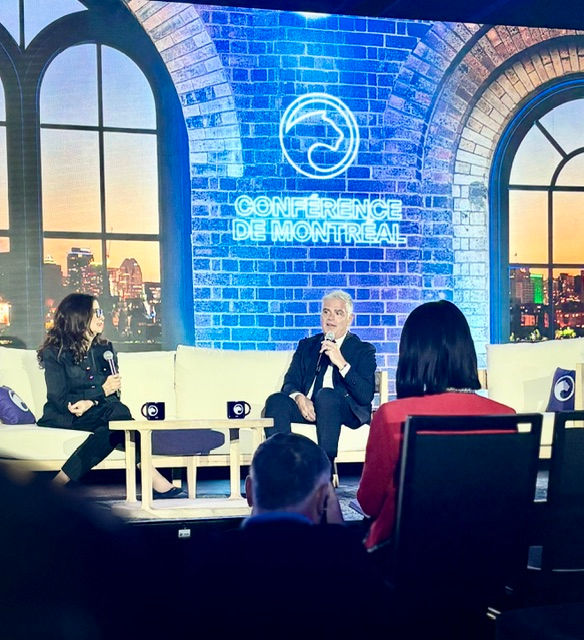
Behind the scenes in the world of hospitality, Omer Acar, head of the Raffles and Fairmont brands, was one of the first to set the tone. Asked about the future of luxury, he recalled a saying heard at Harvard: your job won’t be replaced by a machine, but by someone who masters AI better. Luxury, he insists, rests on human relationships; AI will not replace this connection but will serve as a tool to lighten administrative
tasks and free up time for welcoming guests. Farah, their multilingual voice assistant, already answers calls without mood or delay. Acar therefore chooses to adopt AI for efficiency while keeping it away from what makes his business unique: empathy when “things go wrong”, the ability to sense when a client is tired, frustrated or euphoric.
AI infrastructure and digital sovereignty: the new railways
Sovereignty and infrastructure played a central role. In the session on data centres, Jean Boivin (BlackRock Investment Institute) compared the deployment of AI infrastructure to an industrial revolution: the five big hyperscalers plan more than 600 billion dollars of investments in 2026, three quarters of which are linked to AI, and estimates for 2030 oscillate between five and eight trillion dollars. He reminds that to turn this wave of capital into growth, new revenue sources will have to be created and innovation accelerated. The debate then shifts to the capacity of power grids and public authorities to support such a pace. In the same session, the speakers stress that data centres have become “strategic assets”, comparable to the railways of the nineteenth century, and that their location, energy consumption and public‑private partnerships will determine digital sovereignty.
The panel “Autonomous Economy: security, sovereignty, competition” showed that AI is already integrated into the critical processes of companies. Kamran Ozair and Roshan Shetty explain that the pilots of 2025 have given way to concrete deployments: generative models shorten the time to respond to calls for tenders, sort mortgage files, update product catalogues and plan clinical trials. In financial services, AI is entering compliance, credit decision and fraud detection functions, but institutions start with high‑volume, repetitive tasks in back offices to build trust. The main issue remains traceability: regulators require that decisions made by an algorithmic agent can be audited and reconstructed. Beyond technical considerations, the panellists insist on the need for governance and transparency to prevent the “autonomous economy” from becoming a Wild West.
The theme of sovereignty sparked nuanced exchanges. In the session “Global Race for Innovation and the Future of Large Language Models”, speakers remind that AI has no borders, but that it raises questions of cultural and industrial sovereignty. Anne‑Lise Thieblemont (Qualcomm) speaks of an “age of vapor” where AI seeps into everything, without physical borders but with issues of control. Participants note that the term “sovereignty” is used loosely: some link it to the location of data centres in Canada, others to the nationality of their operators or the residence of the data. For Joëlle Pineau (Cohere), the answer lies in “trusted partners” and modularity: technology stacks must adapt to local cultures and constraints without sacrificing performance or cost.

The Estonian model offers an instructive counter‑example. Erkki Keldo recalls that his country of 1.3 million people took thirty years to become the only nation where 100 per cent of public services (from birth to divorce) are accessible online. This choice is not a luxury but a necessity for a tiny state that must provide efficient services at low cost. The minister emphasises that this success rests on close cooperation between the public sector and companies capable of building innovative systems from a blank slate. Today, Estonia exports its digital know‑how to more than 140 countries and is working on an experimental framework that will allow technologies like autonomous vehicles to be tested despite unsuitable legislation. Estonia shows that digital sovereignty can rhyme with openness and export rather than withdrawal.
The same thread runs through the debate on competitiveness with Ross McInnes, chairman of Safran. For him, speaking of “industrial sovereignty” is incorrect: sovereignty belongs to states, not companies. Industrialists must build their resilience by diversifying suppliers, partially integrating value chains and building up inventories. Behind calls for sovereignty sometimes lies protectionism that McInnes considers contrary to innovation and harmful to consumers. Here again, AI is in the background: it can reinforce factory productivity and optimise logistics, but it does not exempt us from rethinking flows and partnerships in an unstable world.
AI and the professions: judgement does not delegate

The tension between performance and humanity resurfaced in the panel on the transformation of professions. Geneviève Mottard, president of the Order of Quebec Chartered Professional Accountants, rejects the idea that AI will spell the death of accounting. For her, AI is a powerful tool that increases productivity but does not replace professional judgement or ethics: the algorithm has no deontological principles, whereas the accountant remains responsible for his opinion. Mona Malone, chief human resources officer at BMO, adds that the “human plus AI” combination is the most powerful and that it requires rethinking processes and training employees so that they remain actors of change. Dave Chopra, of HCL, insists on the need to support the 59 per cent of employees who will have to be retrained and to help the 11 per cent at risk of exclusion. The rest of the discussion underlined the importance of training students and workers differently so that they develop critical thinking capable of governing AI
“A silicon agent and a carbon agent must be orchestrated.”
In a side remark, a participant, in a falsely light tone, said that a “silicon agent” and a “carbon agent” must be orchestrated. This formula, which was meant to be humorous, chilled me: it betrays a temptation toward Fordism applied to the brain and shows how some imagine a Taylorised division between human and machine. The speaker nevertheless acknowledged that the human must be helped to govern the silicon agent and that channels must be set up to capture the fears and encouragement of teams. Academics remind that training must be anchored in research and develop emotional intelligence, communication skills and critical thinking. Expectations for graduates have exploded: they must be able to analyse the analyses produced by AI without losing their own judgement. I shared practical ground rules in Using AI professionally at work.
In the same spirit, Irish minister Neale Richmond explains that investment must go as much into training as into capital. Instead of chasing very specific skills that become obsolete quickly, he calls for funding fundamental skills and lifelong learning so that talent can adapt as technologies evolve. For a country of five million inhabitants, he says, agility is not a choice but a condition for survival: universities must be able to adjust training to market needs and to react to unforeseen crises.
Governing AI agents: the unglamorous frontier
“Not very sexy”, but essential. — Joëlle Pineau, Cohere

This reflection on training echoes a warning issued by Joëlle Pineau, head of AI at Cohere, during the session on large language models. For her, the next frontier is not a bigger model but robust governance of AI agents: layers are needed to ensure observability, controllability and auditability of systems in order to avoid uncontrolled agents. “Not very sexy,” she concedes, but essential for AI to be trustworthy and to serve businesses and governments. I unpacked what this means for boards in Governing AI: why boards need to use it to understand it.
The divide is not an abstraction
Finally, a round table on transatlantic collaborations showed that the digital divide is not an abstraction. Vincenzo Colla, vice‑president of Emilia‑Romagna, warns against the risk of a technology that polarises: without combining innovation and humanism, we will have a few champions and, beneath them, a “bubble of poor work” made up of companies without a culture of innovation. This divide is not only economic: it threatens social cohesion. Colla calls on Europe and Canada to work together to govern technology, share talent and democratise the benefits of AI.
What AI reveals about our choices
At the end of these sessions, one conviction emerges: AI is not a “sector”, it is a prism that reveals our trade‑offs between efficiency and humanity, openness and sovereignty, short‑term and long‑term. The speakers at the Montreal Conference do not oppose the algorithm to the human: they are looking for ways to use it to free up time, strengthen ethics, create jobs and build infrastructure that will serve everyone. The difference lies in governance. The Estonian example shows that the state can be a facilitator rather than a brake, the debates on data centres remind that investments must come with energy policies and partnerships, and the discussions on professions underline the urgency of training and protecting workers. Making AI a tool for the common good requires making these choices, explaining them and inscribing them in a strategy that is neither reduced to technological euphoria nor to the fear of decline. It is the same discipline I explored in The knife and the cook: adopting AI without losing control.
FAQ: AI at the Conference of Montreal 2026
What was the main AI takeaway from the Conference of Montreal 2026?
AI was not treated as a sector but as a prism. Across sessions on luxury, infrastructure, professions and transatlantic cooperation, speakers framed it as a revealer of trade‑offs between efficiency and humanity, openness and sovereignty, short term and long term. The recurring conclusion: the real differentiator is governance, not model size.
How much are hyperscalers investing in AI infrastructure?
According to Jean Boivin of the BlackRock Investment Institute, the five big hyperscalers plan more than 600 billion dollars of investments in 2026, three quarters of which are linked to AI. Estimates for 2030 range between five and eight trillion dollars, raising hard questions about power grids, the location of data centres and digital sovereignty.
Will AI replace professionals such as accountants?
The speakers said no, with conditions. Geneviève Mottard, president of the Order of Quebec Chartered Professional Accountants, argued that AI increases productivity but does not replace professional judgement or ethics. The human plus AI combination wins, provided organisations retrain the 59 per cent of employees who need it and support the 11 per cent at risk of exclusion.
What is AI agent governance and why does it matter?
AI agent governance is the set of layers that make autonomous AI systems observable, controllable and auditable. For Joëlle Pineau, head of AI at Cohere, it is the next frontier: not very sexy, but essential for AI to be trustworthy enough to serve businesses and governments.
Key takeaways
AI is not a sector but a prism: it surfaced in every conversation, from luxury hotels to data centres.
Infrastructure is the new sovereignty battleground: hyperscalers plan more than 600 billion dollars of investment in 2026, three quarters linked to AI.
Companies build trust by starting with high-volume, repetitive tasks; traceability and auditability are the conditions to scale.
The “human plus AI” combination wins, but 59 per cent of employees will need retraining and 11 per cent are at risk of exclusion.
The next frontier is not a bigger model but robust governance of AI agents.


Comments